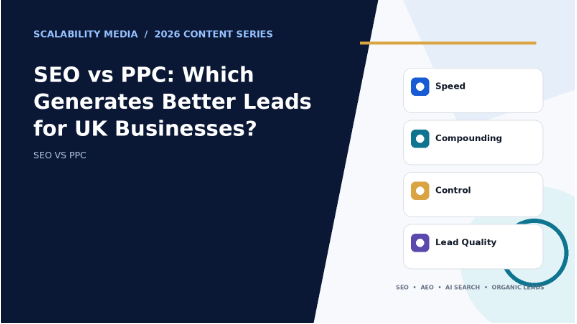
.SEO builds visibility that can compound over time, while PPC can put your business in front of high-intent searches immediately.
SEO and PPC can both generate qualified leads. The better channel depends on how quickly you need demand, how competitive the market is, what a lead is worth and whether you want to build a long-term organic asset or buy immediate visibility.
The most useful question is not “Which channel is better?” It is “Which mix gives this business the best cost, speed and quality of pipeline?”
With PPC, you pay for advertising visibility and can usually launch campaigns quickly. With SEO, you invest in the website, content, authority and technical foundations needed to earn organic visibility over time.
PPC can switch on quickly and switch off quickly. SEO is slower to build, but successful pages can continue attracting traffic after the initial investment.
A new business or new service may not be able to wait months for organic visibility. Search ads can put an offer in front of relevant users immediately if the campaign is set up well.
PPC allows direct control over bids, budgets, locations, schedules and landing pages. That makes it useful for testing offers and validating which queries convert.
For some terms, ads occupy substantial screen space and users are comfortable clicking them. Organic visibility is still valuable, but paid search can capture demand while SEO grows.
A strong service page or guide can rank for multiple related queries and continue producing visits without a cost for every click.
SEO can cover the entire decision journey: problem awareness, comparisons, pricing, case studies and service pages. That creates multiple opportunities to build trust before the enquiry.
In legal, finance, SaaS and other competitive markets, CPCs can make paid acquisition expensive. Organic visibility can reduce dependence on buying every visit, although building that visibility still requires investment.
Lead quality usually depends more on query intent, landing-page fit and qualification than on whether the click was paid or organic.
A high-intent organic query such as “technical SEO consultant for ecommerce migration” can produce an excellent lead. A tightly targeted PPC campaign for the same intent can also produce an excellent lead.
Measure qualified leads, sales opportunities and revenue rather than celebrating raw form counts.
PPC costs include media spend plus management, landing pages and creative/testing. When spend stops, the paid visibility usually stops.
SEO costs include strategy, content, technical work, developer time, tools and authority building. Returns often lag investment, but successful assets can keep working.
This different timing is why comparing a one-month PPC result with a one-month SEO result can be misleading
The best strategy is often coordinated rather than competitive.
Paid campaigns can reveal which commercial queries and messages generate qualified leads. Those insights can inform service pages and content priorities.
If the business becomes organically visible for expensive, proven keywords, it can decide whether to reduce paid spend or use ads to increase total search-result coverage.
SEO can introduce a prospect to the brand, while paid social or search remarketing supports the later decision stages.
An Ahrefs study of millions of advertised keywords found substantial overlap between paid ads and sites already ranking in the top 10 organically. That does not automatically mean the ad spend is wasted; the right decision depends on incrementality, competition and conversion data.
In GA4, track meaningful actions such as lead submissions as key events. Review acquisition and attribution reports rather than relying on platform-reported clicks alone.
For both SEO and PPC, track:
If the sales cycle is long, connect analytics to CRM data so you can see which channel creates customers rather than only form fills
Choose PPC first when speed, testing and control are the priority. Choose SEO first when the market has sustainable search demand and the business can invest for compounding growth. Choose both when the market is valuable enough to justify immediate demand capture and long-term organic asset building
SEO and PPC solve different timing and control problems. Scalability Media uses commercial data to determine where paid speed is worth the cost and where organic visibility can become a durable growth asset.
Not automatically. SEO can require substantial upfront and ongoing investment. Its advantage is that successful organic assets can continue producing traffic without a fee for each click.
Often both at different intensities. PPC can validate demand quickly while SEO starts building the long-term site and content foundation.
They can overlap. Test incrementality and conversion quality for queries where you already have strong organic visibility instead of assuming all overlap is waste.
Transform your online presence and elevate your business with our cutting-edge digital marketing solutions. Ignite success today – choose Scalability Media for results that matter
© 2026 Scalability Media. All Right Reserved.