An AI visibility audit shows how well your brand, content, and website appear across AI-powered search platforms.
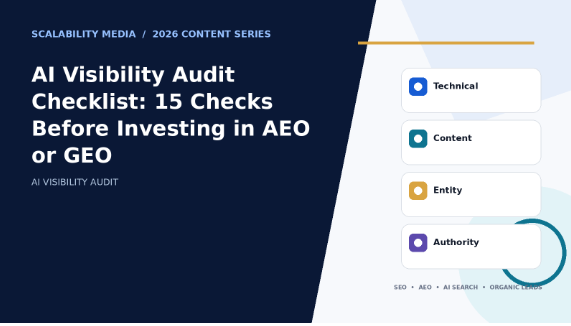
Before a business invests heavily in AEO, GEO or “AI SEO,” it should confirm that the basic visibility system actually works. Many AI-search problems are not exotic. They are ordinary crawl, content, entity and authority issues wearing a new label.
Check robots.txt, CDN rules, server security and firewall settings. OpenAI recommends allowing OAI-SearchBot if you want content to be discoverable and cited in ChatGPT search in business. Review relevant crawler documentation for other platforms as well.
Google states that pages must be indexed and eligible to appear with a snippet to be eligible as supporting links in AI Overviews or AI Mode. Confirm that priority pages return 200 status codes, are not noindexed and use sensible canonicals.
Important service and expertise pages should be reachable through normal internal links. Avoid orphan pages and deep architecture that hides key commercial content.
Compare the company name, address, phone, domain, services and location information across the website and major profiles. Fix contradictions before chasing advanced tactics.
Each major service page should state exactly what is offered, who it is for, what problems it solves and what a prospect should do next. Vague umbrella pages create weak topical associations.
Audit whether the site answers buying questions about cost, timeline, comparisons, deliverables, risks and expected outcomes. These topics are valuable for both search demand and recommendation-style AI queries.
Can a reader find the main answer quickly? Use descriptive H2s, concise definitions, short summaries, tables and lists where they improve understanding. Avoid hiding critical answers under long introductions.
Look for original case examples, process documentation, screenshots, research, benchmark data, expert commentary and lessons learned. Generic summaries are easier to replace than evidence-backed content.
For expert-led or high-trust topics, show who created or reviewed the content and why that person is qualified. Keep author pages and About information useful rather than decorative.
Use relevant schema types such as Organization, LocalBusiness, Article and Breadcrumb where appropriate. Google explicitly says there is no special schema required for its AI features. The markup should match visible page content and business facts.
Search for credible mentions of the company outside its own domain. Review industry publications, partner sites, association pages, relevant directories and review platforms. Note both gaps and inaccurate listings.
For local and service businesses, check review quantity, recency, rating distribution and response quality. Reviews should come from real customers and should not be manufactured.
Flag outdated platform guidance, obsolete statistics, old pricing examples and pages with changed services or locations. Update the substance rather than simply changing dates.
Google recommends supporting useful text content with high-quality images and video where applicable. For complex topics, diagrams, process visuals and original screenshots can improve comprehension and make the page more useful.
An AI-search programme is incomplete without a baseline. Create a stable prompt set, competitor list, citation tracker and conversion measurement plan. Use Google’s generative-AI Search Console reporting for AI Google-specific visibility and separate tracking for ChatGPT, Perplexity and other platforms.
Use a simple three-level status for each check:
Do not average everything into a meaningless score. Prioritise red items that directly affect crawlability, factual accuracy, commercial relevance and proof.
A sensible order is:
This sequence prevents a business from spending on advanced content while fundamental issues still weaken discoverability.
The best AI-search strategy starts by making the business easy to crawl, understand, verify and recommend. Run these 15 checks before adding more tools or content volume. Fixing the fundamentals often creates a stronger return than chasing unproven “AI ranking hacks.”
Yes, but they overlap. An AI visibility audit adds entity clarity, recommendation-query coverage, citation patterns, third-party corroboration and AI-specific measurement to the normal technical and content review.
The labels can be useful for organising work, but the practical execution should remain integrated with strong SEO, content, brand and digital PR foundations.
Run a full audit at least annually or after major site/business changes, with lighter quarterly checks for crawler access, priority content, brand facts and visibility trends.
Transform your online presence and elevate your business with our cutting-edge digital marketing solutions. Ignite success today – choose Scalability Media for results that matter
© 2026 Scalability Media. All Right Reserved.