Get your business recommended by ChatGPT with a strong digital presence, trusted brand signals, and content that clearly answers customer needs.
Getting recommended by ChatGPT is becoming a real visibility goal for businesses that used to think only about Google rankings. Prospects now ask conversational questions such as “Who is the best SEO agency for a growing UK business?” or “Which provider should I use for local SEO?” A brand can be visible in traditional search and still be absent from those AI-generated answers.
The important point is that there is no single “ChatGPT ranking factor” or shortcut that guarantees a recommendation. The practical goal is to make your business easy to discover, easy to understand and well supported by credible information across the web.
OpenAI states that public websites can appear in ChatGPT search and recommends allowing OAI-SearchBot if you want your content to be discoverable, surfaced, cited and linked in search results. Start by checking robots.txt, firewall rules and CDN settings so you are not accidentally blocking access.
Crawl access is only the beginning. A technically accessible site with vague service information still gives an AI system very little confidence about what the business actually does.
Your website should consistently explain your brand name, primary services, target market, location, contact details and areas of expertise. The same basic facts should also be consistent across trusted third-party profiles.
For a service business, the homepage and service pages should answer simple questions clearly: Who are you? What do you do? Who do you help? Where do you operate? What makes your approach different? How can a prospect verify your experience?
Inconsistent phone numbers, addresses, company descriptions or service names make that picture harder to interpret. Entity clarity is not glamorous, but it is foundational for both local search and AI discovery.
Generic marketing copy is rarely enough. Create content that answers the same questions a prospect would ask an AI assistant before choosing a provider.
Useful examples include:
These topics do two jobs. They can attract organic search demand, and they give AI systems clear, quotable explanations about the buying decision.
Statements such as “we are experts” or “we deliver results” are weak because any company can write them. Stronger signals include named case studies, original benchmarks, screenshots with context, process documentation, client outcomes, expert commentary and transparent methodology.
If you say your SEO process improves qualified leads, show how you define a qualified lead and how you measure it. If you recommend a technical SEO fix, explain when it works and when it does not. Specific evidence makes the page more useful to a human reader and more defensible as a source.
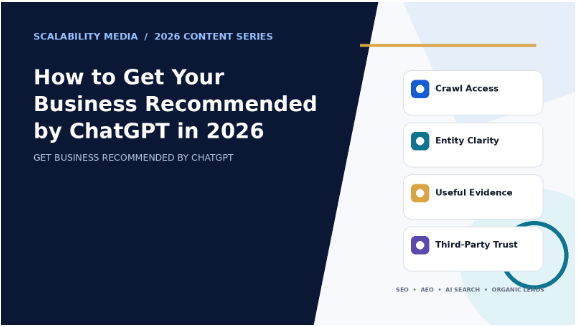
AI recommendation systems do not operate only from your own website. Brand references across reputable industry publications, directories, association pages, review platforms, partner sites, podcasts and expert roundups can reinforce who you are and what you are known for.
Focus on relevance and credibility rather than chasing a high volume of low-quality mentions. A strong industry citation or genuine expert contribution can be more valuable than dozens of generic directory listings.
AI systems often need to extract a clear answer from a larger page. Make important information easy to find with descriptive headings, short explanatory paragraphs, comparison tables, checklists and concise definitions.
Do not flatten every article into robotic bullet points. The best content still needs context, examples and judgment. The goal is clarity, not artificial “AI formatting.”
Recommendations can become unreliable if your site contains old service details, outdated pricing examples, obsolete staff information or contradictory contact data. Review commercial pages and high-value guides on a scheduled basis.
Freshness does not mean changing a publication date without improving the page. Update the substance: current product or service details, examples, platform changes, statistics, screenshots and conclusions.
Google’s current guidance for AI features says normal SEO foundations remain relevant: crawlability and indexability, internal links, useful text content, quality images and videos, accurate structured data and a strong page experience. That is a useful reminder that “AI SEO” should not become a separate set of gimmicks.
A strong strategy improves visibility across Google and AI search together.
Do not judge success by asking ChatGPT one question and refreshing it repeatedly. Build a small, stable set of prompts around your commercial topics and track whether your brand is mentioned, how it is described, whether your website is cited and which competitors appear instead.
Group prompts by intent: category discovery, comparison, pricing, local recommendations, problem-solving and brand validation. This creates a much more useful visibility baseline.
Start with the basics: confirm crawl access, fix inconsistent business information, improve your core service pages and publish two or three high-intent guides that genuinely help buyers compare options. Then strengthen third-party authority and begin tracking AI visibility systematically.
Getting recommended by ChatGPT is less about finding a secret prompt and more about making your business a clear, trustworthy source. Build a technically accessible site, publish decision-support content, demonstrate real expertise and earn relevant third-party validation. That combination gives your brand a stronger foundation for both AI recommendations and traditional organic search.
There is no legitimate organic shortcut that guarantees a recommendation. Focus on discoverability, useful content, verifiable expertise and credible external references.
No, It helps make eligible content accessible to ChatGPT search, but inclusion and citation are not guaranteed.
No special “ChatGPT schema” is required. Use appropriate standard structured data where it accurately represents visible page content.
Transform your online presence and elevate your business with our cutting-edge digital marketing solutions. Ignite success today – choose Scalability Media for results that matter
© 2026 Scalability Media. All Right Reserved.