This guide covers practical ways to improve content structure, authority, and citation potential across AI search platforms.
Being visible in an AI answer is useful; being cited as the source is better. A citation can put your domain directly in front of a user who wants to verify the answer, compare providers or learn more.
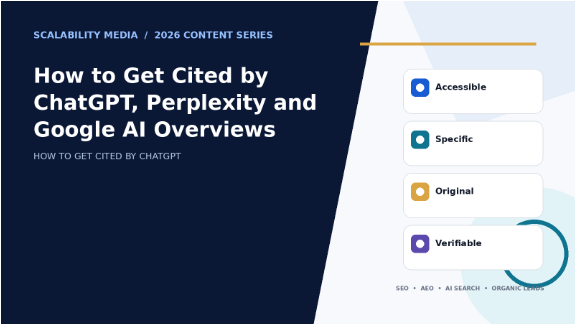
There is no guaranteed formula for earning a citation across ChatGPT, Perplexity and Google AI features. Each system has different retrieval and ranking processes. However, the same qualities repeatedly matter: accessible content, clear answers, original value, reliable evidence and strong relevance to the user’s question.
Start with crawl and index access. OpenAI recommends allowing OAI-SearchBot for content you want surfaced and cited in ChatGPT search. Perplexity similarly documents PerplexityBot for surfacing and linking websites in its search results.
For Google AI Overviews and AI Mode, Google says the page must be indexed and eligible to appear with a snippet. There is no separate AI-only technical eligibility layer.
Check robots rules, noindex directives, canonicals, server responses and security systems before making content changes.
If a section answers “How much does local SEO cost in the UK?”, the first paragraph should provide a useful range with clear caveats before explaining every factor that affects price.
This does not mean reducing the page to shallow summaries. It means structuring the answer so a user can understand the headline conclusion and then choose to explore the detail.
A page that repeats the same generic advice as hundreds of other sites gives a retrieval system little reason to prefer it. Add information that is specific, verifiable and useful.
Examples include:
Original value also makes the article more likely to earn natural links and editorial mentions
When you rely on a platform’s rules, use the platform’s own documentation where possible. When you present a market estimate, explain that it is an estimate and how it was derived.
Clear sourcing reduces ambiguity. It also prevents your article from making absolute claims about systems that change frequently
For recommendation-oriented citations, ensure the business information on the cited page matches the rest of the site and major external profiles. Conflicting locations, phone numbers or service descriptions weaken trust.
Use standard Organization or Local business structured data where appropriate, but treat schema as a way to express facts consistently rather than as a citation button.
A single isolated article is weaker than a coherent topic cluster. Link supporting articles to relevant service pages and connect closely related guides to one another.
For example, an AI visibility hub could connect articles on measurement, citations, crawler access, schema, content structure and competitor analysis. Internal context helps users and search systems understand how the pages relate.
If trustworthy external sources consistently associate your brand with a specialist topic, that can strengthen the evidence around the brand.
Useful channels include digital PR, expert commentary, podcasts, partner resources, professional directories, association sites and original research that other publishers choose to reference.
Avoid turning this into a volume exercise. Relevance and editorial quality matter more than producing hundreds of weak mentions.
Google’s guidance for AI features explicitly recommends supporting text with high-quality images and videos when appropriate. A unique diagram that explains a process can help readers understand a complicated concept and make the page more complete.
Use descriptive filenames and alt text, and make sure the visual matches the surrounding content.
Prioritise pages that contain volatile information: platform capabilities, prices, legislation, product features and current benchmarks. Review them on a schedule and make meaningful changes when the underlying facts change.
A citation to outdated information is not a win.
Do not assume you need a special AI schema type, an “LLM keyword density” formula or repetitive FAQ blocks on every page. Google specifically says no special schema or new machine-readable file is required to appear in its AI search features.
The safest strategy is still to create useful, reliable, accessible content that has a clear reason to exist
AI citations are earned by making a page easy to access and worth referencing. Publish direct answers, original evidence, clear sourcing and current information; then support the page with strong internal context and credible external authority. That approach improves the odds of being useful across ChatGPT, Perplexity and Google rather than optimising for one fragile tactic.
No, You can improve eligibility and source quality, but the final answer and citations depend on the platform, query and available evidence.
No, Use structured data only when it accurately represents the page and is appropriate for the content. It is not an AI citation shortcut.
Relevant links and editorial mentions can help strengthen authority and discoverability, but they should be earned through useful content and credible relationships rather than manipulative schemes.
Transform your online presence and elevate your business with our cutting-edge digital marketing solutions. Ignite success today – choose Scalability Media for results that matter
© 2026 Scalability Media. All Right Reserved.