It covers practical strategies to improve brand visibility, relevance, authority, and inclusion across AI search results.
If ChatGPT repeatedly recommends competitors but rarely mentions your company, the problem is not necessarily that your business is worse. More often, the web contains a clearer and better-supported picture of the competitors.
AI search systems have to decide which sources and brands are relevant to a question. If a competitor has stronger service pages, clearer positioning, more credible third-party references and better-maintained business information, it has more evidence supporting its relevance.
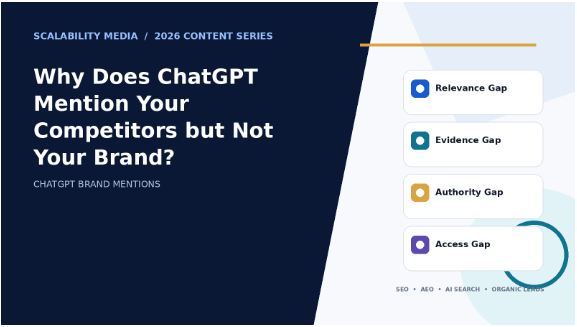
Here are the most common gaps to investigate.
A homepage that says “we help businesses grow online” could describe thousands of agencies. A competitor that clearly says it specialises in technical SEO for ecommerce sites, local SEO for multi-location businesses or SEO for solicitors gives search and AI systems a much stronger relationship between the brand and the problem.
Review your headings, service pages, About content and case studies. Your specialist areas should be obvious without requiring a visitor to interpret vague language.
A competitor may have useful pages about pricing, timelines, audits, comparisons and industry-specific strategy while your site focuses on generic definitions. When users ask recommendation-style questions, those commercial guides provide context an AI system can use.
This is why content strategy should include the questions prospects ask before they contact an agency, not only high-volume top-of-funnel keywords.
Your own website is an important source, but it is still self-published. Third-party references can reinforce what the business is known for.
Look for legitimate opportunities such as expert contributions, relevant industry directories, association listings, interviews, partner pages, awards with transparent criteria and customer review platforms. Avoid mass-produced citations or paid placements that add no real credibility.
A business with different phone numbers, addresses, company names or service descriptions across important profiles creates unnecessary ambiguity. This is especially damaging for local and professional service businesses.
Standardise the core facts about the company, then make sure the website, Google Business Profile and major industry profiles agree.
Before assuming the problem is content, verify the technical basics. OpenAI recommends not blocking OAI-SearchBot if you want content to be discoverable and cited in ChatGPT search. Similar access issues can affect other search platforms.
Check robots.txt, noindex directives, canonical tags, server responses, JavaScript rendering and security tools that may block legitimate crawlers. A brilliant page cannot be used if it cannot be accessed reliably.
Many websites have a short services paragraph and dozens of generic blog posts. That creates breadth without depth.
Build clusters that show sustained expertise around the problems you want to be associated with. For example, an AI-search cluster could cover measurement, citations, crawl access, entity clarity, structured data, content formats and competitor analysis. A local SEO cluster could cover GBP optimisation, location pages, reviews, multi-location architecture and local lead tracking.
Original evidence makes content harder to replace. Useful examples include anonymised case data, before-and-after screenshots, survey results, real implementation lessons, industry benchmarks and examples drawn from client work.
You do not need to reveal confidential information. You do need to move beyond repeating what every other article already says.
Long pages with unclear headings, buried definitions and vague conclusions can make it harder for both humans and machines to understand the main point.
Use descriptive headings, direct answers near the relevant question, clear comparison tables and concise summaries. Keep nuance where it matters, but do not make readers hunt for the answer.
For recommendations, reputation matters. A company with a well-maintained presence, credible reviews and consistent evidence of real customers can look safer to recommend than a business with almost no independent footprint.
Do not manufacture reviews. Build a repeatable process for asking real customers for honest feedback and respond professionally to both positive and negative reviews.
A single prompt is not an AI visibility strategy. Recommendation outputs can vary by wording, context and timing.
Build a test set of 20–50 prompts grouped by intent. Track brand mentions, competitor mentions, cited URLs, sentiment and message accuracy. Over time, this shows whether your visibility is improving across a topic instead of giving you a misleading yes-or-no snapshot.
Start by listing the competitors that appear most often in AI answers for your priority topics. For each competitor, review:
Turn those observations into a gap list. Prioritise the gaps that improve both customer confidence and search visibility.
When ChatGPT mentions competitors but not your brand, treat it as a research problem rather than a mystery. Identify which company is easier to understand, verify and cite. Then close the gaps systematically: positioning, content, proof, crawlability, reputation and external authority.
Not necessarily, AI recommendations can draw on multiple sources and signals. Strong organic SEO often helps, but clear positioning, third-party mentions and accessible content also matter.
Relevant links and mentions can strengthen discoverability and authority, but low-quality link volume should not be treated as a shortcut.
There is no fixed timeline. Changes depend on crawling, indexing, source refreshes, platform behaviour and the strength of the new evidence you create.
Transform your online presence and elevate your business with our cutting-edge digital marketing solutions. Ignite success today – choose Scalability Media for results that matter
© 2026 Scalability Media. All Right Reserved.