SEO costs in the UK vary based on your business goals, competition, website size, and the level of expertise required.
An SEO audit can cost almost nothing or several thousand pounds, which makes comparing quotes difficult. The reason is simple: “SEO audit” can mean an automated crawl export, a specialist technical diagnosis, or a complete review of technical SEO, content, authority, analytics and conversion opportunities.
Recent UK pricing guides published in 2026 often place manual audits for small and medium-sized sites around the mid-hundreds to low-thousands of pounds, with comprehensive and enterprise audits costing more. The important question is not whether an audit costs £500 or £3,000. It is whether the deliverable is deep enough to change decisions.
At this level, expect a tool-generated issue list, basic crawl data or a short consultation. This can be useful as a quick health check, but it should not be confused with a strategic audit.
A software tool can identify broken links, missing titles and technical patterns. It cannot reliably decide which problems are commercially important, whether two pages should be consolidated, or why a competitor is winning a service category.
For a small or medium website, this can cover technical SEO, indexation, on-page patterns, content gaps, internal linking and basic competitor analysis.
The best deliverable includes prioritised recommendations, examples and an implementation sequence rather than a spreadsheet containing hundreds of equal-priority warnings.
A deeper audit may add log or crawl analysis, content cannibalisation, template-level issues, backlink/authority review, analytics validation, competitor gaps and conversion analysis.
This level is often appropriate when traffic has declined, the site has grown organically for years or the business is about to invest significantly in content and SEO.
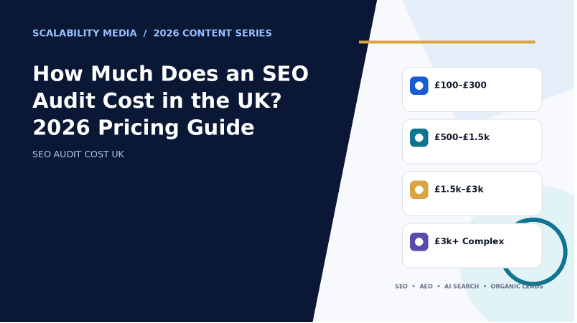
Large sites require more crawling, sampling, template analysis and stakeholder work. Ecommerce, international, JavaScript-heavy and multi-domain sites can quickly move into this category.
At minimum, the audit should answer five questions:
Depending on the site, the detailed work can include status codes, canonicals, robots rules, sitemaps, internal linking, duplicate content, structured data, page templates, Core Web Vitals, content quality, backlink risk, local SEO and analytics.
More pages mean more patterns to investigate. The work does not scale perfectly linearly, but large sites need sampling and segmentation.
JavaScript rendering, faceted navigation, multilingual sections, dynamic parameters and multiple CMS platforms increase diagnostic time
A strong audit may combine Search Console, GA4, crawl data, rank/keyword data, server logs and backlink intelligence. Access, cleanup and interpretation take time.
A business with several services, locations or countries needs an audit that maps technical findings to commercial priorities rather than treating the site as one homogeneous set of pages.
Avoid an audit that ends with “fix all errors.” Ask for:
The audit should help a team execute, not simply prove that the auditor ran a crawler.
A manual audit is especially useful before a redesign or migration, after a sustained traffic decline, when a site has never had technical governance, before scaling content, or when several agencies have worked on the site without a coherent architecture.
If the website has five pages and one obvious problem, a full £3,000 audit may be unnecessary. Good scoping matters.
An audit diagnoses and prioritises. Ongoing SEO implements, tests and iterates. Buying an audit without resources to implement the findings creates little value.
Before commissioning one, decide who will own technical fixes, content changes and measurement after the report is delivered.
Choose the model that fits the work, not the model with the lowest headline price.
SEO audit pricing makes more sense when you compare depth and decision value. Scalability Media focuses on analysis that identifies the highest-impact problems, explains why they matter, and gives your team an implementation plan. A larger document is not automatically a better audit.
It can reveal obvious issues, but free audits are often designed as lead-generation tools and may rely heavily on automated checks. Treat them as a first look, not a full diagnosis.
It depends on site size, access and scope. A thoughtful manual review usually requires enough time to collect data, investigate patterns and prioritise recommendations rather than generating an instant score
For businesses investing in AI search, it is increasingly useful to include crawler access, entity consistency, citation visibility and Google generative-AI reporting alongside traditional SEO checks.
Transform your online presence and elevate your business with our cutting-edge digital marketing solutions. Ignite success today – choose Scalability Media for results that matter
© 2026 Scalability Media. All Right Reserved.