Schema markup can help search engines interpret your website, but it is only one part of AI search visibility.
Schema markup is often presented as a shortcut to AI visibility. The reality is more useful and less exciting: structured data can help search systems understand explicit facts about a page or organisation, but it does not guarantee a rich result, an AI citation or a recommendation.
Google’s current guidance is especially clear. There are no additional technical requirements and no special schema.org markup required to appear in AI Overviews or AI Mode. Existing SEO best practices remain the foundation.
Structured data gives machines explicit information about the entities and content on a page. For a business, that can include organisation name, address, telephone, URL and logo. For an article, it can identify headline, author and publication information. Breadcrumb markup can clarify hierarchy.
This is useful because it reduces ambiguity when the markup is accurate and consistent with the visible page.
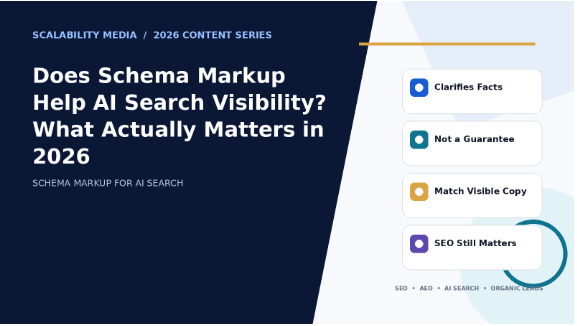
Schema does not create authority that the website does not have. It does not make thin content expert. It does not turn a weak service page into a trusted recommendation source. It does not force Google to show a rich result.
Google’s structured data guidelines explicitly state that correctly implemented markup does not guarantee that a search feature will appear.
No special “AEO schema,” “GEO schema” or “AI Overview schema” is required by Google. Be cautious with claims that adding a proprietary markup block will automatically improve AI rankings and visibility.
Use established schema types because they accurately describe the visible content, not because they contain the word “AI.”
Use Organization markup to express core company information such as name, URL, logo and contact details. Keep those facts consistent with the site and important external profiles.
For businesses with a real local presence, use the most specific Local Business subtype that fits. Google recommends defining each location as a local business and providing applicable business details.
Article markup can clarify article-level information such as headline and author. It should reflect the actual published page.
Breadcrumb structured data can reinforce the page’s place in the site hierarchy and should match a logical user-facing structure.
A common mistake is adding rich structured data while the actual page remains vague. If the service area, author, price or business description is not clear to a human visitor, adding it only in markup is not a strong content strategy.
Google requires structured data to represent the main visible content accurately. Treat schema as a structured expression of truth, not a place to insert extra marketing claims
The strongest use of schema in AI-era SEO is consistency. Make sure the organisation name, address, phone, URLs, service descriptions and people referenced in markup match the website.
For multi-location businesses, each location should have clear location-specific information rather than a generic set of duplicated pages with different city names.
A page can be cited by an AI system without schema. A page can also contain perfect schema and never be cited. Citation depends on relevance, accessibility, content quality and the platform’s retrieval process.
Schema is therefore best viewed as one supporting layer in a broader visibility system.
If your technical basics are already correct, prioritise:
These improvements help real users and strengthen the content that search and AI systems evaluate.
Schema markup still matters, but its role should be understood correctly. Use it to make real page and business information explicit and consistent. Do not treat it as a substitute for useful content, authority, or technical SEO. In 2026, the strongest AI-search strategy still starts with the same fundamentals that make a website valuable and understandable. Scalability Media can apply these fundamentals alongside structured data to strengthen overall search and AI visibility.
Not by itself. For ChatGPT search, crawl access and useful, credible content are more fundamental. Standard structured data can still help express business facts clearly.
No, Google says there is no special structured data required for AI Overviews or AI Mode.
No, Add properties that accurately describe the page and are useful. More markup is not automatically better.
Transform your online presence and elevate your business with our cutting-edge digital marketing solutions. Ignite success today – choose Scalability Media for results that matter
© 2026 Scalability Media. All Right Reserved.