
Service Architecture
Creating clearer pathways around consulting, training, evaluation, practice support, PHN work, and other important capabilities.
While rebuilding Larter’s website around a clearer search structure, Semrush shows a strong rise in estimated organic traffic, a larger ranking keyword footprint, and increasing visibility within AI-related search features toward the end of the displayed period.
The supplied Semrush data shows organic performance moving upward while the website structure is being rebuilt, with particularly strong growth appearing toward September and October.
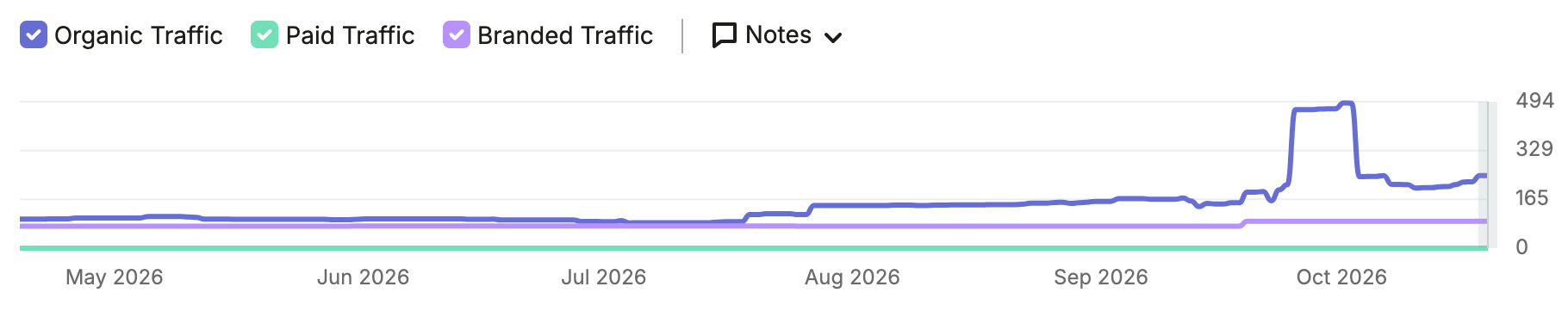
Semrush shows estimated organic traffic beginning around 50–60, building gradually through August and September, and accelerating sharply near October. The trend reaches a peak close to 490 before settling near 240 at the end of the displayed period—still roughly four times the early baseline.
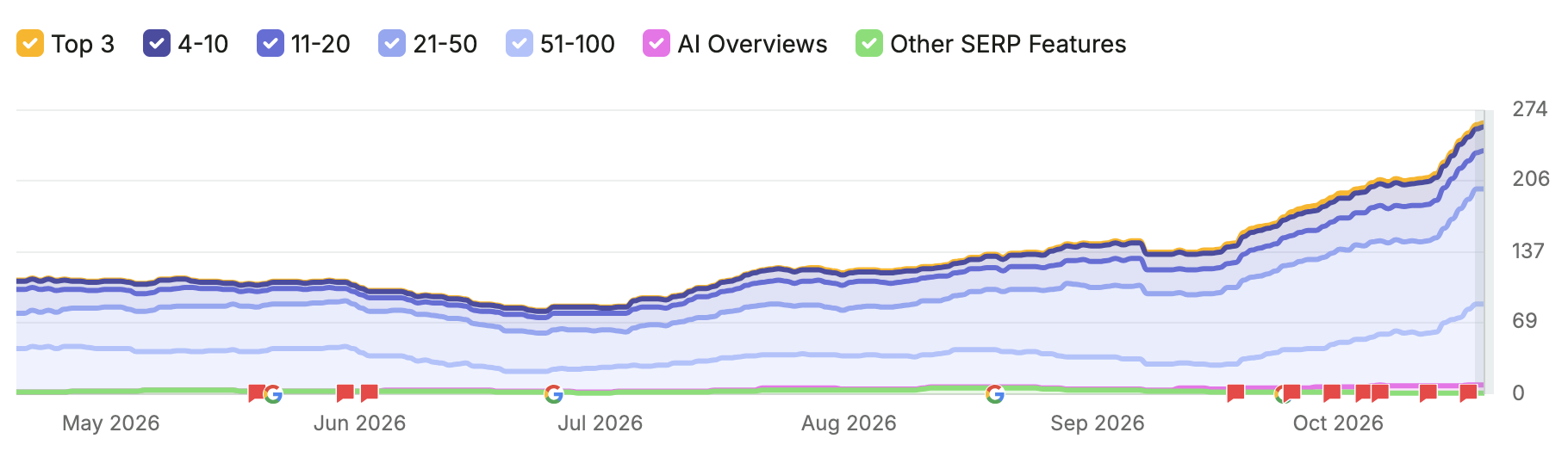
The ranking footprint dips during the middle of the period while the website structure is being rebuilt, then recovers strongly. By October, Semrush shows roughly 260 ranking keywords compared with around 110 near the beginning, while AI Overview visibility also becomes increasingly visible in the later period.
Data source: Semrush Organic Research. Traffic figures are third-party estimates and are used as directional indicators rather than first-party analytics totals. Semrush AI Overview tracking reflects search-feature visibility and should not be interpreted as a guaranteed or exact count of AI citations.
Larter operates across multiple areas of primary healthcare consulting, including consulting, education and training, evaluation, practice support, and work with Primary Health Networks. That breadth creates a significant opportunity—but also requires a clear site architecture so search engines and users understand where each service and topic belongs.
During the rebuild, the goal is not simply to protect every historic URL or maintain an inflated keyword count. The new structure is being designed to give important services, audiences, topics, and informational resources clearer ownership.
As older pages are reorganized, consolidated, or repositioned, rankings can temporarily move. That is visible in the Semrush keyword chart around June and July.
The positive result is what follows: the ranking footprint begins expanding again and reaches its strongest level in October, alongside a much higher estimated organic traffic trend.
The new structure is being developed around Larter’s specialist expertise, service areas, health-sector audiences, useful resources, and the relationships between them.
Creating clearer pathways around consulting, training, evaluation, practice support, PHN work, and other important capabilities.
Giving priority search themes a defined primary page so individual URLs have clearer purposes and are less likely to compete with one another.
Organising expertise, thought leadership, service information, and sector-specific content around clearer topical relationships.
Making it easier for health organisations, Primary Health Networks, practices, government stakeholders, and other audiences to reach relevant expertise.
Connecting related services, resources, case studies, and expertise so users and search engines can better understand topical relationships.
Supporting crawlability, indexability, redirects, canonical signals, semantic structure, and the technical requirements of the new site architecture.
The supplied Semrush data begins to show stronger AI-related search visibility toward the later part of the period. The rebuild is therefore not focused only on conventional rankings; it is also designed to make Larter’s expertise easier for AI-assisted search systems to interpret, retrieve, and connect with relevant healthcare questions.
The supplied Semrush charts show a clear recovery and expansion after the middle of the period: estimated organic traffic moves to a much higher level, ranking keyword coverage expands, and AI-related search visibility begins appearing more strongly.
A website rebuild can create temporary movement in keyword counts while old pages are reorganised, consolidated, redirected, or given clearer purposes. What matters is whether the resulting structure is stronger and easier to understand.
In Larter’s case, the supplied Semrush data already shows the ranking footprint recovering beyond its earlier level, estimated organic traffic moving substantially higher, and AI-related visibility beginning to increase as the new search foundation develops.
We can help restructure your website around stronger search intent, clearer topic architecture, technical SEO, useful content, and the signals that support visibility across both traditional search and emerging AI experiences.
© 2026 Scalability Media. All Right Reserved.