
Procedure Page Architecture
Organising procedure and treatment topics into clearer search pathways so priority medical services have defined page ownership and stronger supporting relationships.
A focused Medical SEO and Answer Engine Optimization strategy helped expand organic visibility across plastic-surgery searches, move Semrush-estimated traffic to its strongest level in the supplied period, and increase visibility across AI-assisted search features.
The supplied Semrush charts show substantial growth across estimated organic traffic, ranking keyword coverage, stronger ranking-position groups, and AI Overview visibility during the displayed period.
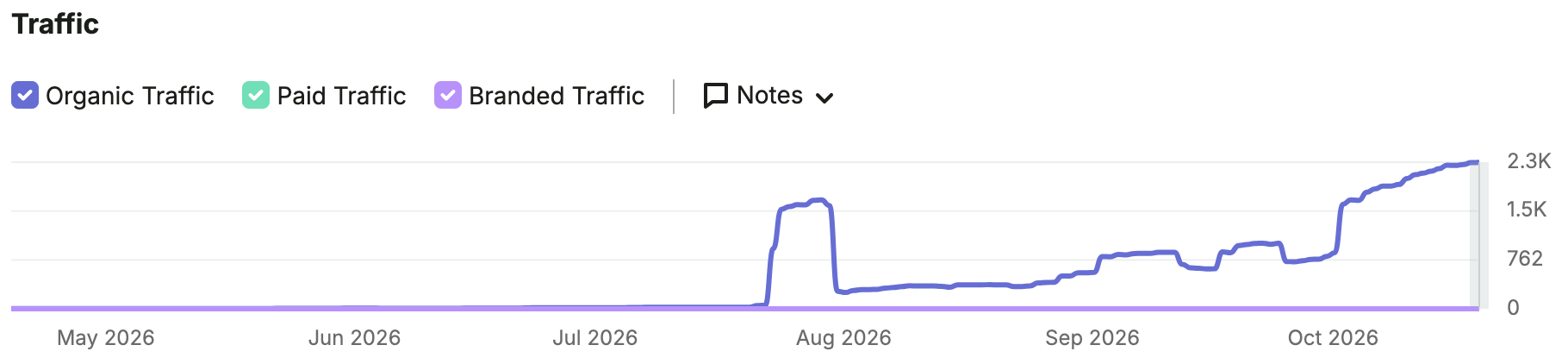
The Semrush trend remains limited through much of the early period before moving sharply upward from late July. After several growth stages through August and September, estimated organic traffic accelerates again in October and reaches approximately 2.3K at the end of the supplied period.
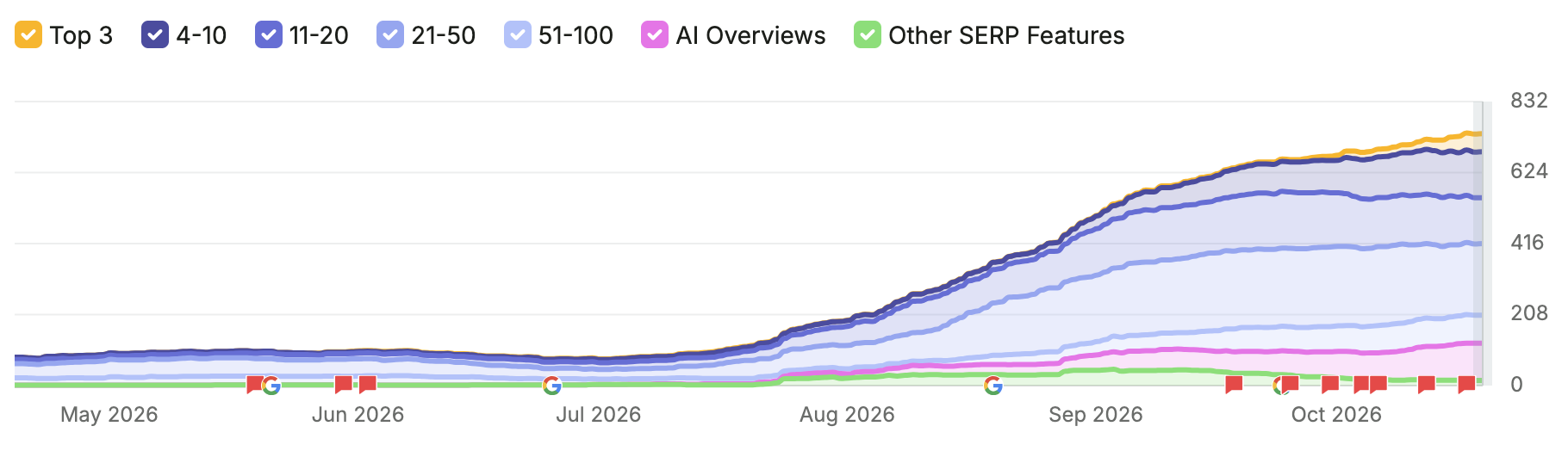
Semrush shows the overall ranking footprint moving from fewer than roughly 100 terms near the beginning of the period to approximately 700 or more by October. Visibility also grows across stronger ranking bands, while the AI Overviews line becomes increasingly prominent through August, September, and October.
Data source: Semrush Organic Research. Organic traffic figures are third-party estimates and should be treated as directional search-performance indicators rather than first-party analytics totals. AI Overview data reflects Semrush-tracked SERP visibility and does not represent a guaranteed or exact count of AI citations.
Plastic-surgery search journeys can begin with a specific procedure, an aesthetic concern, a recovery question, a comparison, or research about a surgeon before a patient is ready to request a consultation.
The opportunity was to create a broader search footprint across cosmetic procedures, reconstructive services, patient questions, treatment research, and location-driven queries while maintaining clear relationships between the site’s most important pages.
For a medical website, the strategy also needs to support clear authorship, understandable procedure information, useful patient education, strong entity context, and answer-ready content that modern search systems can interpret confidently.
The strategy connects traditional organic SEO with answer-focused content structure so important procedure pages and educational resources can support discovery across both conventional and AI-assisted search experiences.
Organising procedure and treatment topics into clearer search pathways so priority medical services have defined page ownership and stronger supporting relationships.
Structuring content around the questions patients research about procedures, candidacy, preparation, recovery, benefits, limitations, and related considerations.
Strengthening headings, page focus, contextual terminology, metadata, location relevance, and semantic relationships across priority pages.
Expanding useful educational coverage to create additional search entry points for people researching procedures before moving toward a consultation.
Connecting treatment pages, supporting resources, patient information, and related procedures to create more understandable topical pathways.
Reinforcing clear information about the surgeon, specialist expertise, service categories, location context, and supporting medical content throughout the site.
The supplied Semrush chart shows AI Overview visibility moving upward during the same period that the site’s wider organic ranking footprint expands. AEO supports that opportunity by making important medical information clearer, more direct, better organised, and easier for search systems to retrieve in response to specific questions.
The supplied Semrush charts show organic traffic, total ranking coverage, stronger ranking bands, and AI-related search visibility all moving materially upward during the displayed period.
The performance pattern is broader than a single keyword or traffic spike. The site’s organic ranking footprint expands substantially across the period, more terms move into stronger ranking positions, and Semrush-estimated traffic reaches its highest level near the end of October.
At the same time, the increasing AI Overview signal shows why Medical SEO and AEO now need to work together: procedure expertise must be discoverable through traditional search while also being structured clearly enough for answer engines and AI-assisted search experiences.
We can help build a Medical SEO and AEO strategy around stronger service architecture, patient search intent, answer-ready content, technical SEO, and AI-search visibility.
© 2026 Scalability Media. All Right Reserved.