
Service Page Architecture
Creating clearer search pathways around disability evaluations, workplace evaluations, VA-related services, forensic psychology, and therapy.
A focused SEO and Answer Engine Optimization strategy helped expand organic search visibility across psychological evaluations, disability-related services, forensic services, therapy, and question-led mental health searches while building a stronger foundation for AI-assisted discovery.
The supplied Semrush charts show estimated organic traffic moving to a substantially higher level while the website also expands its overall ranking footprint across stronger organic positions.

The Semrush trend begins near approximately 120 estimated monthly organic visits in May and moves upward in multiple stages through June, July, August, and September. By the end of October, estimated traffic reaches roughly 350—the strongest level visible in the supplied period and close to three times the early baseline.
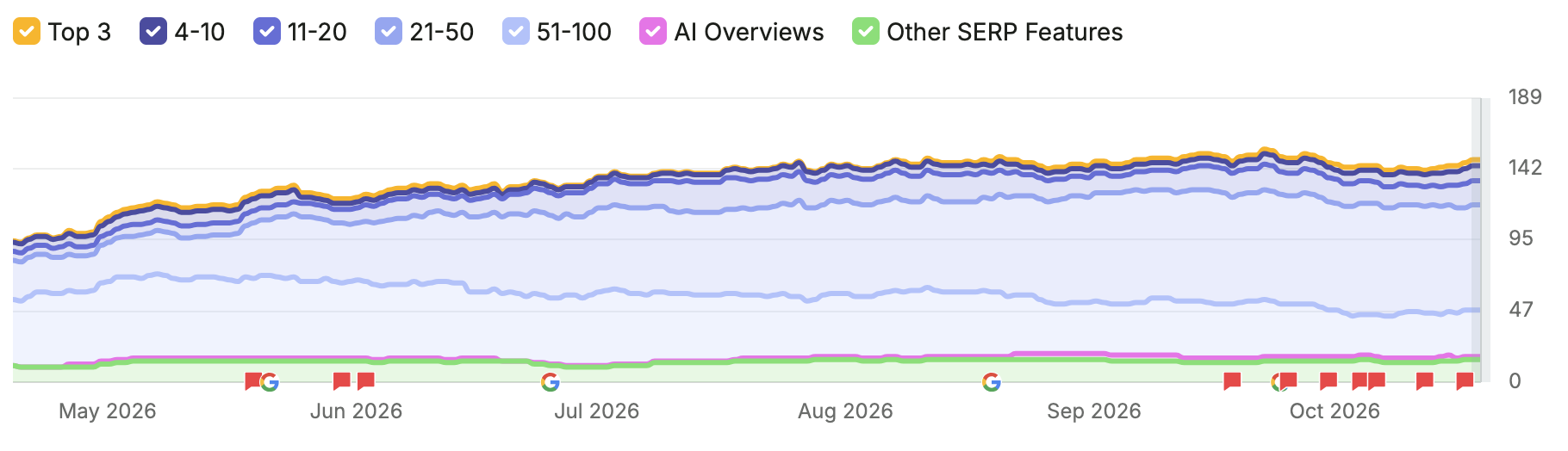
The ranking footprint begins at roughly 90 organic keywords and expands toward approximately 140 or more by October. The chart also shows visibility across stronger ranking bands while AI Overviews remain present as an additional search feature throughout the later period.
Data source: Semrush Organic Research. Organic traffic values are third-party estimates and are used as directional indicators rather than first-party analytics totals. AI Overview reporting reflects Semrush-tracked SERP-feature visibility and should not be interpreted as an exact or guaranteed count of AI citations.
Psychological-service searches can be highly specific. People may search for a disability evaluation, workplace documentation, a VA-related psychological opinion, forensic expertise, therapy, or an answer to a detailed question before they know what type of service they need.
California Psychological covers several distinct areas, including disability evaluations, workplace accommodation and leave evaluations, VA-related assessments, forensic and expert-witness services, and therapy.
The SEO opportunity is therefore broader than ranking one service page. Search engines need clear relationships between services, evaluation types, audiences, common questions, clinician expertise, and supporting information so each search intent has an understandable destination.
The strategy aligns specialized psychological services with question-focused information so the site can support both high-intent service searches and users researching complex evaluation processes.
Creating clearer search pathways around disability evaluations, workplace evaluations, VA-related services, forensic psychology, and therapy.
Structuring useful answers around eligibility, evaluation processes, documentation, timelines, and common questions users research before scheduling.
Strengthening headings, metadata, semantic context, search-intent alignment, and page-level relevance across priority psychological service pages.
Using clear question-and-answer content to address common concerns around evaluations, documentation, forensic services, and related processes.
Connecting related evaluations, supporting resources, service information, clinician context, and question-led content through purposeful internal linking.
Reinforcing clear relationships between the practice, licensed psychologists, service types, geographic context, virtual care, and supporting psychological information.
The Semrush chart shows AI Overview visibility as part of the site’s organic search footprint. While the AI signal remains smaller than the website’s traditional ranking footprint, its presence matters: mental-health and evaluation searches increasingly involve generated answers alongside conventional organic results.
The supplied Semrush data shows estimated organic traffic moving steadily upward while the ranking footprint also expands beyond its early-period level. AI Overview visibility adds another developing search surface to the site’s broader organic presence.
The strongest signal in the supplied data is the sustained rise in estimated organic traffic combined with a broader ranking footprint. More search terms and stronger search positions create more ways for people to discover relevant psychological services.
AI visibility adds another opportunity. Clear clinician context, focused service pages, useful question-and-answer content, and stronger topic relationships help create a website that can be understood across both traditional search and newer AI-assisted experiences.
We can help build a healthcare SEO and AEO strategy around high-intent services, clear topic architecture, useful answers, technical SEO, and AI-search readiness.
© 2026 Scalability Media. All Right Reserved.