Ranking multiple business locations requires more than creating separate location pages—it takes a consistent, scalable local SEO strategy.
Ranking one location is a local SEO project. Ranking ten locations is an operating system. Every branch creates another set of competitors, reviews, business details, local links and conversion data that must remain accurate without turning the website into duplicated city pages.
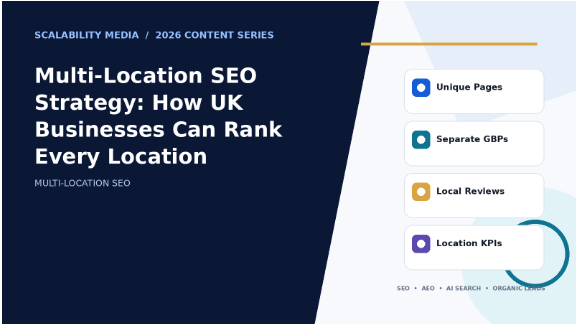
A scalable multi-location strategy needs central governance with local relevance.
Create a dedicated landing page for each genuine location. The page should include more than an address and a swapped city name.
Useful local information can include:
The page should be useful to someone deciding whether to visit or contact that location.
Eligible physical locations should have their own accurately managed profile. Keep names, categories, services, phone numbers, URLs and hours consistent with the corresponding landing page.
Google says local results are mainly based on relevance, distance and prominence. A multi-location strategy therefore needs accurate information and local reputation at each branch, not only a strong corporate SEO strategy.
Copying one page 20 times and changing the city name creates weak user value. Central brand information can be shared, but the page should also contain locally relevant details.
If two branches offer different services or serve different customer groups, make that distinction obvious.
A simple structure might be:
/locations/
/locations/cambridge/
/locations/norwich/
/locations/ipswich/
Then link location pages from a central locations hub and from relevant service content. Avoid burying branch pages several clicks deep.
For businesses where each location has several distinct services, use internal linking carefully so the architecture remains understandable rather than exploding into hundreds of thin combinations.
Google recommends defining each local business location as a LocalBusiness type and using the most specific applicable subtype. Mark up the real address, phone and other relevant properties and ensure they match the visible page.
Schema should reinforce accurate location data; it should not invent a presence in cities where the business has no real location.
A strong head-office review profile does not automatically solve reputation for every branch. Create a compliant process that asks customers to review the specific location they used.
Monitor rating, recency, review themes and response quality by location. Branch-level review data can also reveal operational issues that SEO reporting would miss.
Look for partnerships, sponsorships, suppliers, professional groups, local publications and community organisations that genuinely relate to each branch.
A multi-location brand should not use identical link-building tactics in every city. Local authority should reflect real local activity.
Create a master source of truth for every location: official name, address, phone, URL, hours, categories and opening date. Use it to update major directories and profiles.
This prevents branches, agencies and staff from publishing conflicting information over time.
Site-wide organic traffic can hide local wins and losses. Build reporting for each branch:
Compare branches carefully because market size and competition differ.
Do not create fake office locations simply to rank in more cities. Build location/service-area content only where it represents a real service relationship and offers unique value.
For a business with one physical base serving a region, the site architecture may need service-area pages rather than multiple LocalBusiness entities.
As the number of locations grows, define owners for:
The strategy fails when no one knows whether the marketing team, branch manager or agency owns the data.
Multi-location SEO succeeds when every branch has accurate data, a useful local page, its own reputation signals, and measurable lead performance, all governed by one scalable system. Scalability Media helps businesses build local relevance without sacrificing brand consistency.
For genuine locations you want users and search engines to understand separately, a useful dedicated page is usually the clearest approach.
Some brand/service information can repeat, but the page should contain meaningful local information and should not exist solely to swap city names.
Use accurate LocalBusiness markup for eligible real locations and make sure the information matches the corresponding page and business profile.
Transform your online presence and elevate your business with our cutting-edge digital marketing solutions. Ignite success today – choose Scalability Media for results that matter
© 2026 Scalability Media. All Right Reserved.