This 2026 pricing guide breaks down typical SEO costs, pricing models, and what businesses should expect from an SEO investment.
How much should a UK business pay for SEO in 2026? There is no regulated industry price, and public agency pricing varies widely. A small local campaign, a national ecommerce programme and an enterprise technical SEO engagement are fundamentally different products even when every supplier calls the service “SEO.”
Recent UK pricing guides commonly place smaller consultant or entry-level retainers in the hundreds of pounds per month, established SME programmes in the low thousands, and full-service or highly competitive campaigns at several thousand pounds per month or more. Treat these as planning ranges, not official market rates.
This budget can work for a small local business with a limited site and a narrow geographic target. The scope may include basic technical checks, on-page improvements, Google Business Profile support and a modest content plan.
The risk is not the price itself; it is an unrealistic scope. If a proposal promises technical SEO, weekly content, digital PR, extensive link building, local SEO and detailed strategy for £400 per month, ask how many skilled hours can realistically be delivered.
This range can support a more complete programme: technical maintenance, content strategy, on-page optimisation, linking building ,reporting and some authority building.
For many service businesses, this is where SEO becomes a coordinated growth channel rather than a list of monthly tasks.
Competitive industries, larger sites and multi-service businesses often need several specialists: strategist, technical SEO, content, digital PR/link acquisition, developer support and analytics. The cost increases because the work is broader and the opportunity cost of mistakes is higher.
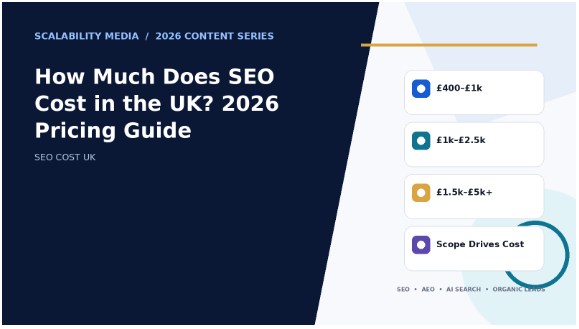
Large ecommerce sites, national brands, international sites, migrations and highly competitive lead-generation markets can require dedicated technical resources, content teams, digital PR and stakeholder management.
Ranking for a low-competition local service is different from competing nationally for legal, finance, SaaS or ecommerce terms. More competition usually means more content depth, authority building and time.
A 25-page brochure site is easier to audit and maintain than a 100,000-URL ecommerce platform with faceted navigation, JavaScript rendering and international sections.
A clean, crawlable site with useful content can move directly into growth work. A site with duplication, poor architecture, migration errors and weak tracking may need months of corrective work first.
High-quality content costs more when it needs original research, expert interviews, legal/medical review, custom graphics or specialist knowledge.
If competitors have years of editorial links, reviews and brand mentions, closing that authority gap may require digital PR and stronger assets rather than simply publishing more blog posts.
Multi-location and international SEO add operational complexity: location pages, local profiles, hreflang, regional content, reviews and separate measurement.
A monthly retainer is usually best when SEO is an ongoing growth channel. A project fee can work for migrations, audits or one-time technical remediation. Hourly consulting is useful when an internal team needs senior strategy or troubleshooting rather than execution.
Choose the model that fits the work, not the model with the lowest headline price.
A strong proposal should explain:
Avoid proposals that promise guaranteed number-one rankings or rely entirely on vague deliverables such as “100 backlinks” without quality standards.
No. A senior freelancer with low overhead can sometimes deliver excellent focused work at a lower price than an agency. The question is whether the scope, expertise and available time match your needs.
Cheap SEO becomes risky when the supplier must automate or outsource everything to make the economics work, or when the campaign depends on manipulative links and mass-produced content.
Start with commercial value rather than a generic percentage of revenue. Estimate the value of a qualified organic lead, the close rate, the average customer value and the realistic opportunity in your market.
Then ask what level of investment is required to build the assets that can capture that opportunity. SEO should be evaluated against pipeline and customer acquisition, not only rankings.
The right SEO price is the cost of the strategy and execution required to achieve a realistic business goal. Scalability Media recommends comparing proposals by scope, expertise, measurement, and expected commercial value rather than choosing the cheapest monthly number.
Public 2026 UK pricing guides show a broad market from several hundred pounds per month for narrow/local support to £5,000+ for larger or highly competitive programmes. Scope is the main variable.
A small business should choose a budget that can fund the specific work it needs. A focused local campaign may require far less than a national growth programme.
You can reduce activity, but search results, competitors, content and websites keep changing. Ongoing maintenance and improvement are usually needed to protect and grow performance.
Transform your online presence and elevate your business with our cutting-edge digital marketing solutions. Ignite success today – choose Scalability Media for results that matter
© 2026 Scalability Media. All Right Reserved.