SEO can generate leads, but the timeline depends on your competition, website authority, search intent, and strategy.
Businesses often ask, “How long will SEO take before we get leads?” A responsible answer cannot promise an exact month because the timeline depends on the website, competition, authority, technical condition and the type of query being targeted.
A useful planning model is to treat SEO as a sequence of milestones rather than a guaranteed countdown.
The first month should establish the baseline. Confirm Search Console and GA4 tracking, identify priority services, map keywords to URLs, crawl the site and fix critical accessibility or indexation problems.
Some businesses can see early improvements from correcting obvious issues such as broken redirects, poor titles, weak internal links or a page that already ranks on page two. A brand-new domain should not expect the same speed as an established site with years of authority.
This phase usually focuses on service-page improvements, internal linking, content gaps, technical cleanup and early authority work.
You may begin seeing more impressions, better positions for long-tail queries and incremental non-branded traffic. Lead volume may still be inconsistent, especially in competitive sectors.
Use this period to verify that Google is crawling and indexing the right pages and that the content matches the queries you intended to target.
For established sites with a sound foundation, three to six months is often where a pattern becomes easier to evaluate. Supporting articles can strengthen service topics, internal links distribute authority and refreshed pages have had more time to be recrawled.
This does not mean every campaign should “rank in six months.” It means there should be enough evidence to judge whether the strategy is producing the right direction: broader non-branded visibility, more qualified visits and early lead growth.
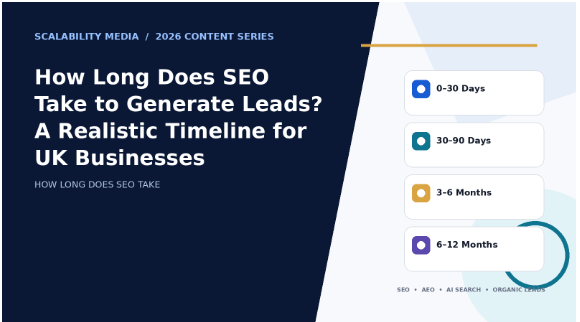
Harder commercial terms often need sustained content quality, authority and iteration. At this stage, the team should know which clusters convert, which pages need consolidation and where competitors still have stronger proof or links.
This is also where ROI reporting becomes more meaningful because enough leads have had time to progress through the sales pipeline
New websites have little history and few external signals. They often need more time to build topic depth and authority.
Legal, finance, SaaS and high-value local services often have mature competitors investing continuously in content and links.
Indexation, canonicalisation, JavaScript rendering, duplicate templates or migration errors can suppress the value of content work until the technical issues are fixed.
An agency can identify fixes in week one, but results will not follow if developer tickets sit untouched for three months. SEO speed is partly an organisational issue.
Publishing generic articles that repeat competitors rarely creates a strong reason to rank. Original evidence, specialist experience and better search-intent alignment can improve the quality of the programme.
A 2025 Ahrefs study found that only a small percentage of newly observed pages in its sample reached Google’s top 10 within a year, depending on the filtering method, and that older pages dominated many top results. That is useful evidence that competitive ranking is not automatic.
It is not a prediction for your business. An existing service site improving a page that already ranks can behave very differently from a brand-new URL on a new domain.
Track:
If none of the leading indicators improve after several months, do not simply “wait for SEO.” Reassess the strategy, page quality, competition and implementation.
Give pages enough time to be crawled and evaluated, but do not leave underperforming content untouched indefinitely. If a page has strong impressions but weak CTR, improve the snippet and intent fit. If it ranks 8–20 for months, strengthen the content, internal links and authority. If Google does not index it, diagnose technical and quality issues.
SEO is slow compared with switching on an ad campaign, but it should still be managed actively.
SEO lead generation is a compounding process, not a fixed countdown. Use the first 90 days to build and validate the foundation, the next three months to measure meaningful movement, and the following months to strengthen what is proving commercially valuable. Scalability Media focuses on building SEO strategies that turn growing organic visibility into measurable, qualified leads over time.
Yes, especially if the site already has visibility and the work fixes high-impact issues. It should not be promised as the normal outcome for every site.
No, Six months is a useful review milestone, not a guarantee. Competition, domain strength, implementation and search intent all affect timing.
Look for better non-branded visibility, impressions, relevant clicks, indexation, commercial landing-page traffic and early key events.
Transform your online presence and elevate your business with our cutting-edge digital marketing solutions. Ignite success today – choose Scalability Media for results that matter
© 2026 Scalability Media. All Right Reserved.